

Archives in Video Games: SEASON: A Letter to the Future
Spoiler Alert! I'm not trying to give everything away, but I do talk about later sections of the game. You've been warned!
Author's Note: I was not aware of the claims of abusive behavior surrounding Scavangers Studio's creative director and CEO before purchasing this game. I want to be clear, it's NEVER okay to create a hostile working environment and any sexual harassment, verbal or physical, should result in immediate termination if the allegations are credibly investigated and found to be true. The fact that the developers had no HR department at the time of the accusations, and the two running the studio were romantically involved, leaving employees with no recourse, is unconscionable. It is especially upsetting when the surrounding controversy effected the release of what is a gorgeously realized game, which resulted in low sales and eventual layoffs.
Memory work is one of the foundations of the archival profession. First-hand accounts, diary and journal entries, and oral histories are the backbone of archival collections, museum exhibits, and historical research. We need people to remember the world they inhabit and the many cultures in which they participate because it serves to invigorate and expand our understanding of what makes us Us. Memory is a core aspect of the human experience. It's how we build bonds and create community, it captures significant moments through the senses, and, at times, it acts as a disruptive counter-narrative to the establishment.
It's also fallible when one factors in time and distance from events, which is why supporting documentation as well as corroborating accounts serve the purpose of strengthening memory work while also acknowledging that The Truth cannot fully exist within the archives. We will only ever be left with the remnants of someone's lived experience, never the full scope, but that doesn't mean we can't glean important lessons from what's been left behind or what doesn't exist.
With that understanding in mind, SEASON: A Letter to the Future has a solid footing in the archival world even if the journey is rooted in interrogating the spiritual and philosophical nature of memory through the individual and the world at large. You play as Estelle, a young woman who ventures out into the world to record everything she can as another season comes to an end. Seasons, in this case, serve as periods of time in which war, advancement, peace, societal shifts, etc., take place. There doesn't seem to be an agreed upon catalyst to the ending of one season and the beginning of another, but with the passing of each season there remains the collateral damage that affects some of the population in the aftermath.
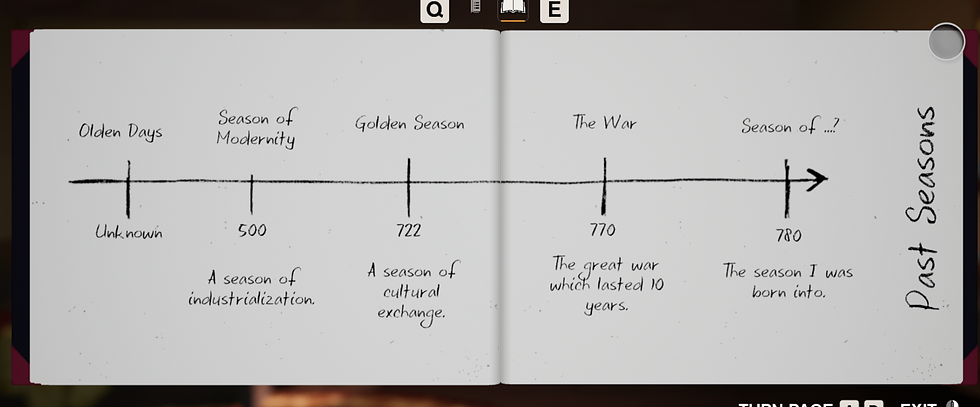
As Estelle ventures away from her village, she comes across places that have survived the ravages of time as well as people in various states of preparedness for the season's end. Through it all, Estelle takes notes, photographs, sketches, and makes recordings of the places and people she encounters with the goal of turning her journal over to the Museum Vault, located at the edge of the earth, so others will know what happened.
Right off the bat, this game is gorgeous. One of the mechanics requires Estelle to ride a bicycle along a mostly obvious path and it really doesn't hit you as a player how big the world is until the scale of Estelle versus the landscape finally shifts. It gives everything weight and a true sense of place but it also serves to tell the grander story of past seasons without overly relying on exposition. Estelle passes machinery reclaimed by nature and massive structures crumbling even as they remain standing, but there are also lush fields of grass and grain, a world teeming with life and varying forms of prosperity even as the uncertainty of the future looms over them.

However, the primary mechanic of the game centers on Estelle's journal. It's not a new mechanic in games by any means. Having a "notebook" or a "journal" is just an in-game reason for keeping track of important information for the player to reference as they progress. But in SEASON, Estelle's journal is the whole point of the game. From the start, the player is shown how to take pictures and make recordings to save in the journal, where they're referred to as Keepsakes. Depending on where Estelle is on her journey, the keepsakes will correspond only to those pages in the notebook. Once a certain amount of keepsakes are acquired and placed within the pages, Estelle will offer more insights and questions surrounding the area in which the keepsakes were made. The player is then rewarded with extra quotes, sketches, and stickers to add to the pages.
What I love about the use of the journal is that no two journals between players will be the same. Aside from a few pages that advance certain story beats, the player doesn't have a prescribed list of keepsakes to include in the pages. Once you take a picture or record something, the game will tell you where that keepsake can be accessed but it's up to the player to decide whether they put it on the page. Some keepsakes might reward you with additional insights from Estelle, but if you want to keep taking pictures of skylines or landscapes, maybe a weird monkey, or a grave marker from fifteen different angles, then feel free to do so. It gives the player, and by extension Estelle, agency over what they think is important to include while reinforcing the thematic interactions surrounding memory as it relates to the past, present, and the future.


It definitely turns the collection process into a scrapbooking event, but it makes sense from a character point-of-view. Estelle doesn't necessarily have a reference for what is and isn't archival/historical material, so she's essentially adding anything and everything because, to her, it's all important to the future people who will one day read her journal. And once we learn the truth around what it means to end a season, her efforts to collect and document the outgoing season have greater significance. The most generous read you could make of the situation is that Estelle is engaging in guerrilla archiving, a method of grassroots rapid-response acquisition and preservation of records and data made vulnerable in the face of censorship, neglect, or destruction. It's not a new form of archival practice by any means, but it is relevant to the political and social climate of the game.
Outside of the gameplay, the writing it where SEASON really shines. Writers Meg Hutchison and Jane Tan maintain a subdued, almost cozy vibe as Estelle continues her journey, but there's never a feeling of being rushed. The game gives you plenty of moments to sit and think along with Estelle. You're allowed to close your eyes and listen to rainfall and croaking frogs and wind chimes in the same way that you're encouraged to listen to poetry, music, and prayers. The game doesn't ask you to choose one over the other because they're all inextricably linked in how we process and retain memories.
I think the strongest sections of the game happen with Estelle's interactions with Kochi and Matyora in Tieng Valley. For context, the valley residents have been ordered to evacuate by nightfall before the government destroys the dam and floods the valley as a physical and metaphorical end to the season.
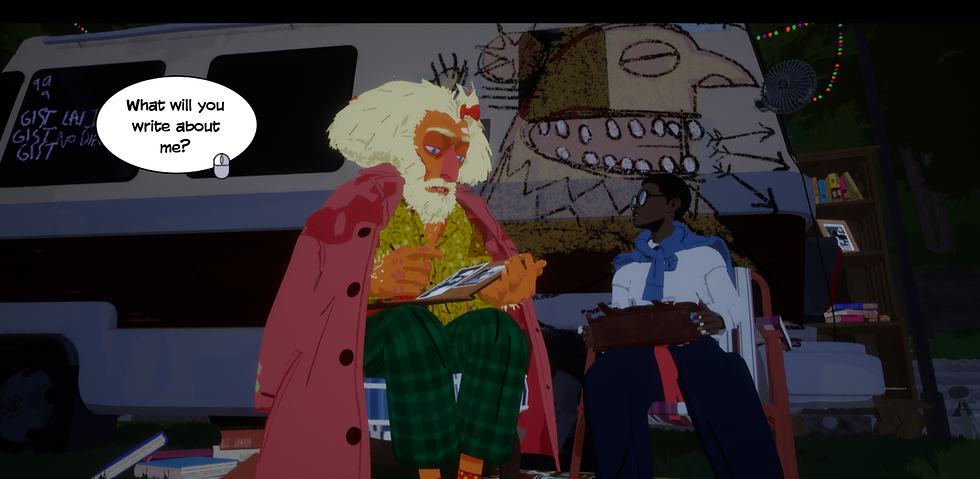
Most likely, the player finds the fruit farm first and meets Sophon. In her effort to downsize for the evacuation, she asks Estelle to help her choose "artifacts" from her own life to bring alone, most of them connected to either her son, Kochi, or to her late husband, Yuri. Once you've helped Sophon, Kochi will offer to show you around the valley, basically giving you a guided tour for what will be the rest of the game. The tour ends at the cemetery where you visit Yuri's grave and have a moment with Kochi as he wrestles with what it means to leave the valley and his father behind. Prior to entering the valley, Estelle reveals that her own father passed away a while ago from a disease that affects a person's memory and perception of time; a disease similar to what Yuri passed from. While sitting with Kochi at his father's grave, you're given the option to record the story of Estelle's father's death as she shares it with Kochi.
What I like about this is that the writers are putting the decision in the player's hands, as they've done the entire time, as to whether or not something needs to be recorded. It's truly the first time the player is confronted with what it means to reject the archive and allow something to be forgotten by the historical record. Yes, the player has made decisions about what pictures and quotes they put in the journal, but there was a cushion of distance in that aspect of the game. Estelle often acts as the objective observer to her surroundings, even in her home village of Caro. Her curiosity is the initial motivation to get her out the door, but a lot of her personal life is delivered piecemeal throughout the game. By the time we reach the cemetery in Tieng Valley, the player knows how much Estelle's father means to her and how his death affected her and her mother. So, when given the option to record that story, the player must ask themself: Is the Memory Vault entitled to her story?
When Estelle meets Matyora, the player is further along in the game and has more than likely seen a great many sculptures in the valley. They are, in fact, the work of Matyora, an artist obsessed with capturing a moment, THE moment, before Tieng Valley floods and her work is washed away by time and Tide. The segment offers some of the best writing on the duality of art as the artist criticizes her work with each photograph Estelle brings. There's a parallel to Matyora trying and failing to encompass all of a thing - in this case, Tieng Valley - in one piece of art and Estelle's efforts to do the same through her documentation. Her journal contains so many photos and recordings, but is it enough? Can Estelle say she's fully captured the end of the season in her journal? And the answer is no. One can only glimpse a version of a moment, a place, a person, an event because there's too much complexity and context to distill into something easily consumed. Like art, archives can only capture part of a story. We can fill in the gaps as much as possible, but it will ultimately be left unfinished.


Comments